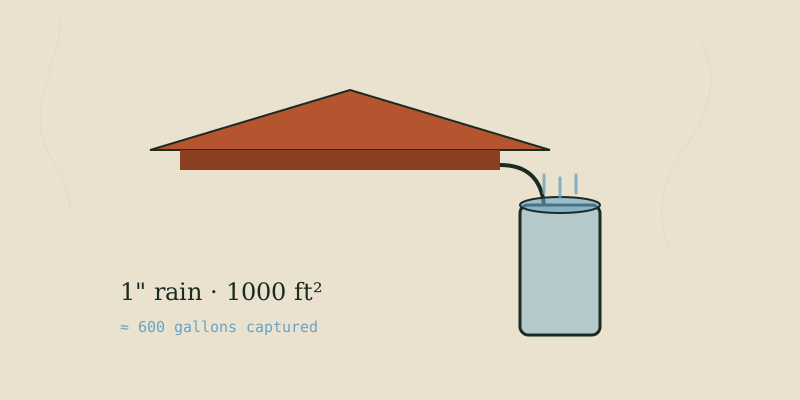
Water is the constraint on almost every garden and homestead, and rain is free water falling on a collection surface you already own: your roof. The math is genuinely surprising. One inch of rainfall on 1,000 square feet of roof yields roughly 600 gallons. In a place that gets 40 inches a year, that's tens of thousands of gallons running off your roof and into the storm drain every year.
The simple math
Catchment in gallons ≈ roof footprint (ft²) × rainfall (inches) × 0.623. So a modest 1,200 ft² roof in a 1-inch rain catches about 750 gallons. You don't need a mansion to harvest serious water — you need gutters and somewhere to put it.
The basic system
Collection
Your roof and gutters. Metal roofs are cleanest; avoid catching from roofs treated with moss-killers if you'll use it on edibles.
First flush
A simple diverter that dumps the first few gallons — which carry dust, bird droppings, and debris — before clean water reaches the tank.
Storage
Barrels (cheap, small) or tanks/cisterns (hundreds to thousands of gallons). Opaque containers stop algae.
Distribution
Gravity-fed if your tank sits uphill of the garden, or a small pump. A spigot and hose is enough to start.
Sizing your storage
Match storage to your dry spells, not your rainfall. If you get regular rain, a few barrels buffer between storms. If you face long dry summers like we do, you want the biggest tank you can afford and site — because the goal is to bank the wet season's abundance to carry the garden through the drought.
Beyond barrels: shaping the land
The most advanced rainwater harvesting isn't in tanks at all — it's in the soil. Swales (level ditches on contour), berms, and mulch slow water down and let it soak into the ground where plant roots can reach it. 'Slow it, spread it, sink it' is the mantra. A well-shaped landscape stores far more water in the soil than any tank, and it does it for free.
Using it wisely
Drip irrigation delivers stored water straight to roots with almost no waste to evaporation — it can use a fraction of the water of a sprinkler for the same result. Pair rainwater catchment with drip and mulch and you can grow through a dry summer on a tiny fraction of municipal water.
Written by Jordan Polasek, founder of Texas Roots, from his greenhouse in El Campo, Texas. Free to share. If this helped, the best thanks is to grow something or pass it along.